


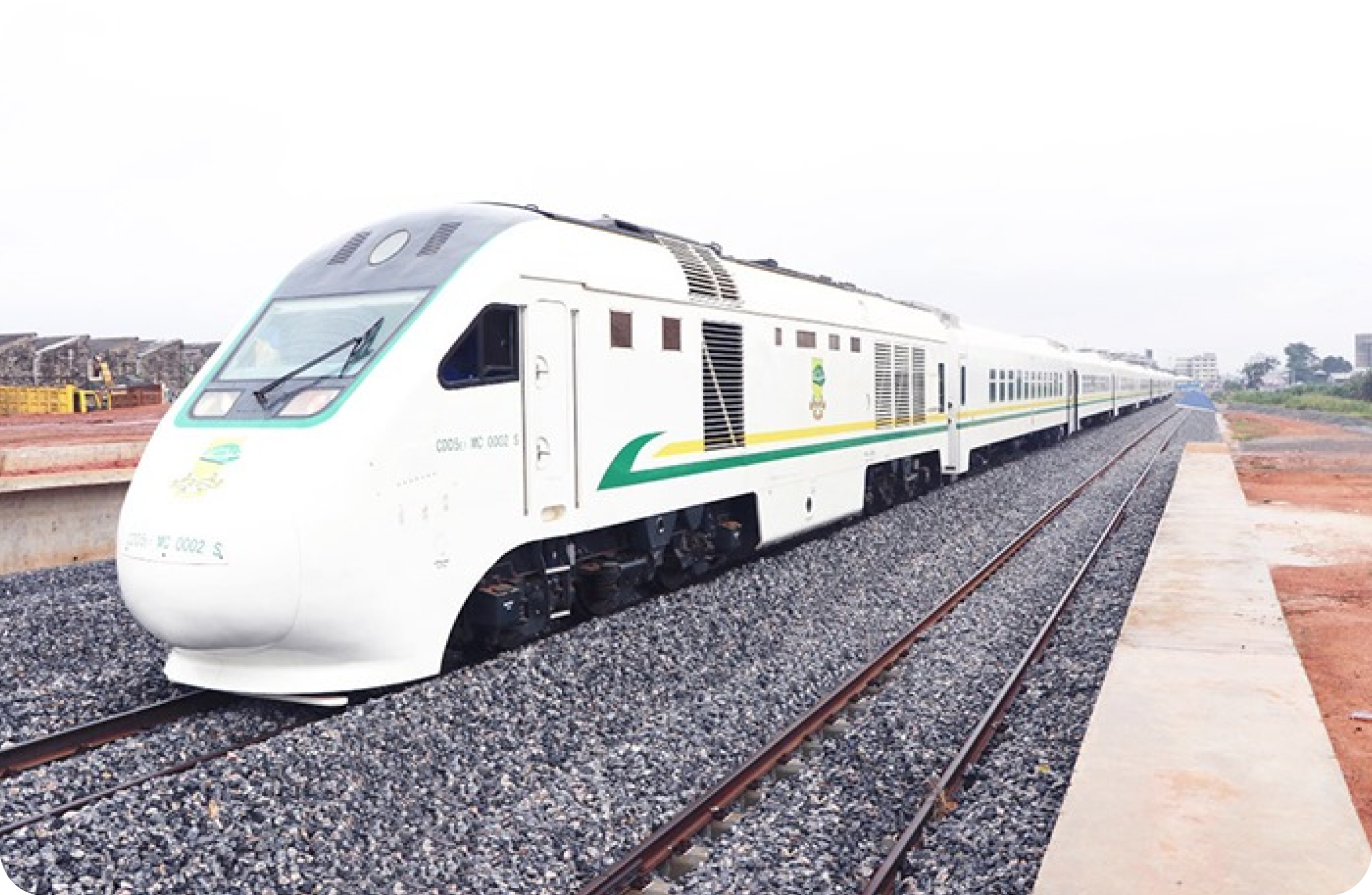

Railway modernisation: How far, so far?
- Railway
- August 6, 2025
- No Comment
- 292
By Lanre Abdul
Two years into the administration of President Bola Ahmed Tinubu, it has been a mixed bag of expectations, unfulfilled dream and lofty aspirations for the railway modernisation programme of the federal government to link all Nigerian state to the railway network, how far has the present administration gone in building on the achievements of its predecessor?
The railways sub-sector of Nigeria’s Transportation ecosystem saw significant improvement during the administration of former President Muhammadu Buhari. After the railway sector was in a long lull for over a decade, the system was revived by the administration and the once abandoned system came back on stream.
The revitalisation of the old narrow gauge from Lagos to Kano signalled a new beginning for the return of railways in 2012.
However, the construction of the Kaduna-Abuja standard gauge which was commissioned in 2016 was the beginning of railway modernization in Nigeria.
The project conception started in 2006 under the Olusegun Obasanjo administration when the China Civil Engineering and Construction Corporation (CCECC) was contracted to build the Lagos-Kano Standard Gauge Railway which is a 1,343-kilometer line.
But due to paucity of funds, it was segmented beginning with the Kaduna-Abuja section (187 kilometers) awarded by the Goodluck Jonathan’s administration after securing the concessionary loans of $500m from the CCECC.
The project was commissioned in July 2016 by the Muhammadu Buhari administration, making it the first standard gauge to be operational in Nigeria.
The Lagos-Kano Standard Gauge Line was designed to connect every part of the country with faster, more efficient and modern train services.
Following the commissioning of Abuja-Kaduna, the Buhari’s administration started the Lagos-Ibadan Standard Gauge in 2017 and completed it before the end of the administration and it is now operational. Similarly, the Muhammadu Buhari-led administration prior to the commissioning of the Lagos-Ibadan standard gauge, had earlier in September 2020 commissioned the 326-km Itakpe-Warri-Ajaokuta standard gauge railway, the very first standard gauge in Nigeria abandoned over 33 years ago.
The project awarded in 1987 was to link the mines at Itakpe to the Ajaokuta Steel Mill and to the Port City of Warri.
Also the immediate past administration flagged off the Kano-Katsina-Jibiya-Maradi-Kano-Dutse railway on February 9, 2021. The project has also been conceived over the years and actualized by the Buhari’s administration. The preliminary studies for the project being undertaken by an European Engineering Firm, Mota-Engil, started as far back as 2012 predating even the present administration.
Transport Agenda reports that the rail line formed part of the LAKAJI (Lagos-Kano-Jibiya) economic corridor aimed at positioning Nigeria to be the destination port for Niger-bound containers as the West African neighbour (though no longer a member of ECOWAS) is a land-locked country.
With former Minister Rotimi Amaechi as the Minister of Transportation, the railway sector was a beehive of activities under the immediate past administration, leaving a mighty shoe for the incoming administration to fill.
After the completion of the Lagos-Ibadan section of the Lagos-Kano Standard Gauge, the federal government was expected to start with the Ibadan-Ilorin segment. In fact Amaechi in October 2020 disclosed that the federal government has commenced acquiring right of way for the Ibadan-Kano section of the standard gauge.
However, the project’s take off was stalled due to paucity of funds as the anticipated funding from China did not materialise. But through budgetary allocation, the federal government in 2021 commenced work on the Kano-Kaduna section.
The scope of the project involves a 203-kilometer double track standard gauge railway from Kano to Kaduna at a cost of $1.2bn without variations on the scope of work agreed as of that time. The Federal Government immediately released over $220 million to CCECC to commence work.
Findings by this medium showed that the project was about 20 per cent completed when the last administration elapsed.
As of 2023 when the Tinubu’s administration took over, projects critical to the railway modernisation initiative worth over N16 trillion were inherited. With the present exchange rate, the project costs would have doubled.
The projects include the Ibadan-Kano Standard Gauge Railway ($5.3bn); $11.17bn Lagos-Calabar coastal railway project; the $3.02bn rehabilitation project for the Eastern Line (Port Harcourt-Maiduguri) and the $1.9bn Kano-Maradi Railway project.
The $11.17bn Lagos-Calabar coastal railway project which had been in the pipeline for almost two decades was in 2021 approved by the Federal Executive Council (FEC) during the Muhammadu Buhari-led administration.
It would be recalled that in 2016, China and Nigeria signed an agreement for the over $11billion contract to build the coastal railway which was to start before the end of 2018. However, that project is yet to see the light of the day. Instead the government has, through the Ministry of Works, been concentrating on the Lagos-Calabar coastal road though with planned railway tracks in between.
Going by the current exchange rate, the government would require at least N50 trillion to fix the projects under the railway’s modernisation programme.
This, according to insiders, explains why the various projects have been stalled but the government is exploring alternative funding models to fast-track the project.
As a low hanging fruit, the present government in November 2024 handed over the completed section of the Eastern Narrow gauge line covering 62 kilometres from Port Harcourt to Aba to the NRC.
The $3.02bn Eastern Line (Port Harcourt-Maiduguri) project was also started by the previous administration. In fact the project was flagged off amidst pomp by former President Buhari on March 9, 2021. However, for reasons of funding the project was segmented and the first section stopped at Aba and it is now operational.
According to the Managing Director of the NRC, Comrade Kayode Opeifa, the Tinubu’s administration has made efforts to continue the railway modernisation programme of the immediate past government as it is the same APC government.
He stated that the commitment of the Tinubu-led government has brought improvement in the railway sector through the prioritisation of the ongoing projects.
He said, “To start with, you’ll recall that prior to the coming of President Muhammadu Buhari, there was a lull in the railway sector in Nigeria. However, with the coming in of the APC administration of Buhari, the modernisation project was reignited with the completion of Abuja-Kaduna, Warri-Itakpe. And then the ground-breaking of Lagos-Kano project, with the completion of Lagos to Ibadan Standard Gauge and the commencement of the Port Harcourt-Abuja rehabilitation of the narrow gauge.
“Now, when Asiwaju Bola Ahmed Tinubu came, the administration completed the Port Harcourt-Aba. You know, the barriers in certain areas were still completed. Okay. During the first year, it was completed and it was open for commercial operation. And today, that service is taking care of people from Port Harcourt, especially traders going to Aba and Enugu to trade. That’s number one.”
Opeifa stated that the present administration is credited to have completed the Lagos-Ibadan standard gauge and deployed ticketing solutions on the service in order to eliminate ticket racketeering, adding that there is improved security across train corridor.
Lagos-Ibadan cargo service revived
Also the freight movement on the Lagos-Ibadan Train Service was revived to boost revenue on the service. This is to maximise the benefit of the railway not only for the movement of passengers but goods and cargoes.
It would be recalled that it took over two years before freight movement continued on the service. At a point, the Project Manager for the Lagos-Ibadan service, Mr. Xia Lijun once said while passenger service has continued since commissioning, to make profit in the operation of the track, freight service must resume.
But the freight service from Apapa was relaunched recently in partnership with APM Terminals which facilitated evacuation of cargoes from Apapa Port to Moniya Ibadan where there is an Inland Dry Port.
It was learnt that container traffic is scheduled for Mondays, Wednesdays and Fridays with each train trip carrying 35 units of 40ft or 70 units of 20ft Containers or a mixture of both sizes.
This implies that each trip would take 35 trailers or 70 trailers carrying containers off the roads between Lagos and Ibadan thereby reducing incidents of containers falling on Lagos roads.
The MD while giving an update on the ongoing projects disclosed that the government plans to link Apapa Port with the Tin-Can Port while taking the Lagos-Ibadan line further to Abuja via Oshogbo and taking the Port Harcourt-Aba to Enugu via Umuahia.
He added, “We have also accelerated the Kaduna-Kano, which is now over 60% completed, the same thing with the Maradi-Kano and we are projecting that by next year one of them will become operational.”
“Now, in terms of revolutionizing the rail sector, this government ensured the complete constitutional reform, that is the greatest achievement, by putting rail on concurrent list, meaning that states can now come on board. Four states are taking advantage of that. Lagos, Kaduna, Kano, and Ogun state and under one of its programs, the track access program, the Lagos state government took advantage of the track access and that is the red line operation. This government has also provided seed grants of about N400 billion to four states. And that is facilitating rail development within the state to complement and take advantage of the national corridor.”
Speaking with our correspondent, a transportation expert, Dr. Taiwo Salaam said the present government is trying its best to revive the railways sector but said it can still do better. He stated that the 25-year railways development roadmap unveiled by the Olusegun Obasanjo administration should be religiously implemented to fast-track the development of the railway sector.
He said, “I know that the government is trying its best to revamp the railway. Remember that there was a 25-year rail development plan which brought in the CCECC (China Civil Engineering and Construction Corporation) to develop the standard gauge. The development of the railway could have been better and faster if not for bandits and because of people stealing and vandalising railway equipment.”
