



Work progresses after phase one commissioning of Lagos-Calabar highway
- Road
- August 6, 2025
- No Comment
- 664
By Lanre Abdul
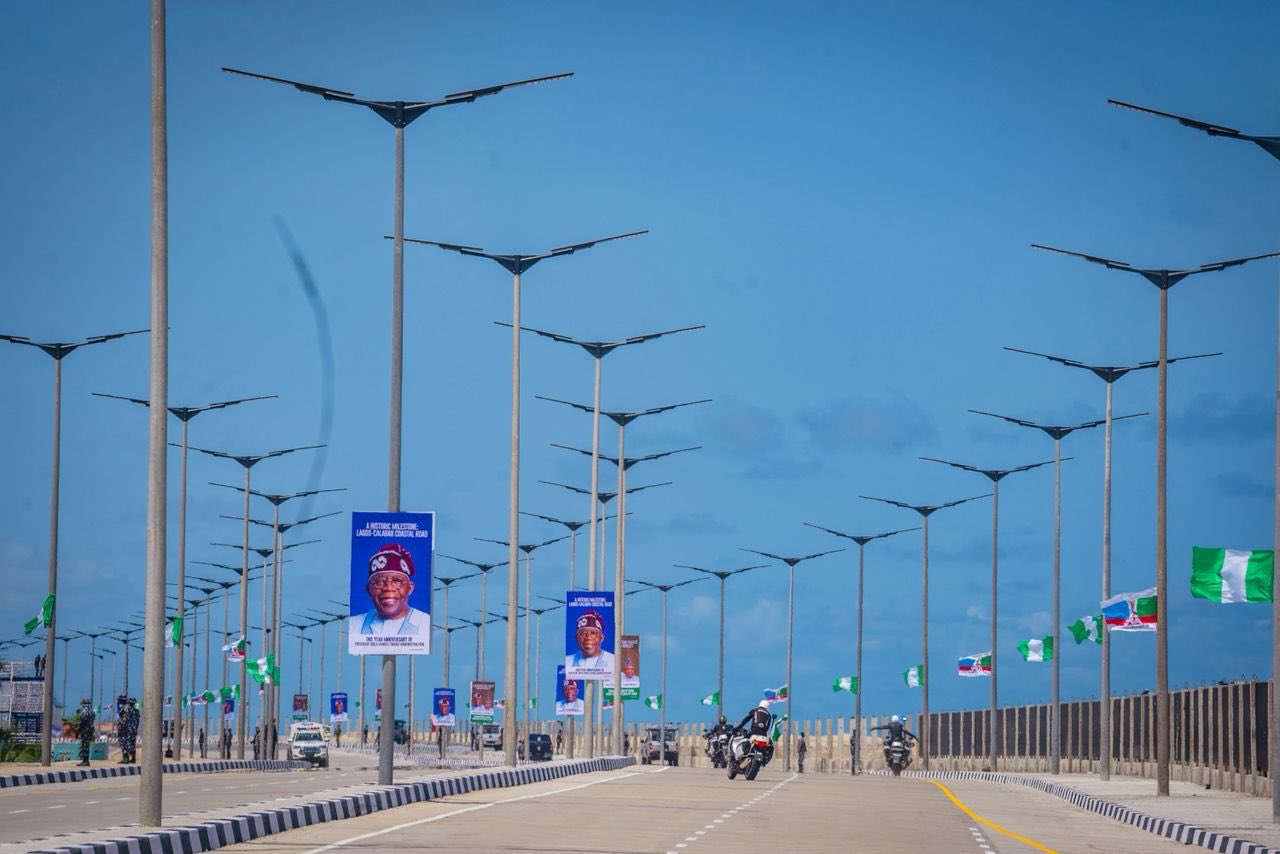
The road is a four-lane highway from the former Bar Beach/Victoria Island Entry Point built with concrete pavement. The Minister of Works said the road, with the concrete pavement, can withstand 40 to 50-year pressure. From four lanes, it becomes three lanes as we drive through the smooth concrete road. In between were streetlights neatly placed on both sides of the road. The waves of the Atlantic Ocean by the right were a good sight to behold as the journey progressed but it wasn’t long until we got to the part of the road where work is still ongoing.
At Kilometer 15, the road became impassable due to the ongoing construction of a bridge which is part of the project. But in the middle of the construction trucks, vehicles were being redirected by officials of the construction company. Many officials wearing reflective vests were on ground controlling the vehicular movement.
As observed by this Reporter, work is progressing steadily. Hundreds of workers were working on the site while their supervisors were on ground providing the coordination.
The drive continued from the bridge along the sandy paths which are yet to be paved. From the ongoing bridge construction down, signs of ongoing construction are visible everywhere. The route path has been secured as excavation works continue further down given the swampy terrain ahead.
Though, none of the site engineers was ready to speak with this Reporter saying they were not authorised to speak with the press, one of them who volunteered said the terrain from kilometer 15 requires a lot of excavation works and sand filling but the right of way is secured down to the Ogombo end of the highway.
For many, the Lagos-Calabar highway is an ambitious project. From Victoria Island, Lagos, it is passing through Ogun State; Ondo State; Delta State; Bayelsa State; Rivers State and Akwa-Ibom State.
Many could not help but imagine the transformation that would spring up on the corridor when the road finally kicks off. This is why many observers say the Tinubu-led administration has chosen to take the bold, daring move when many hesitated to begin. It is described as a futuristic project that would change the infrastructural landscape of Nigeria and significantly reduce travel time from Lagos to Calabar to about 7 hours.
But there is no gain without pain. The construction of the road has come with inconvenience to many residents, businesses along the corridor especially in Lagos. Many residents were displaced and businesses were also affected with demolition carried out before the commencement of work.
So far, the federal government disclosed that it has paid N18b as compensation for Section One of the project even as it battles with lawsuits over some of the demolished properties. There are indications that more money would be paid in compensation as the work progresses.
A resident of Alpha Beach, Hezekiel Adigun acknowledged the inconvenience and disruptions the project has caused to residents and businesses. He disclosed that his shop was demolished alongside hundreds of others. “My shop is not a big shop like that. I used to sell phone accessories around the Jakande side but now it has given way. I am back here at Alpha Beach where I relocated my business. I think we should just understand that to build infrastructures like this, something has to give way.
“I can tell you I am happy with what I am seeing. I never imagined this place could be opened up like this. I hope the government can complete the project as promised. It will really improve the economy of this place especially and the states that would benefit from the project.”
Fresh loan for project
Meanwhile, the federal government has disclosed plans to spend $747 million on the Lagos-Calabar Coastal Highway project following the recent approval of an additional $47 million external loan to fund the project.
The new loan was captured under the government’s 2025–2026 external borrowing plan request approved by the lawmakers yesterday.
Tinubu, in his letter to the lawmakers, said the adjustment to the borrowing plan was due to an increase in the funding requirement for the project, whose cost rose from $700 million to $747 million, a $47 million increment.
He said the projects, under the revised borrowing plan, were selected based on rigorous economic evaluations and their projected contribution to national development goals, including job creation, skill development, promotion of entrepreneurship and poverty reduction.
