



Leading the Way: Women in Transportation
- AviationMaritimePipelineRailwayRoad
- March 31, 2026
- No Comment
- 18
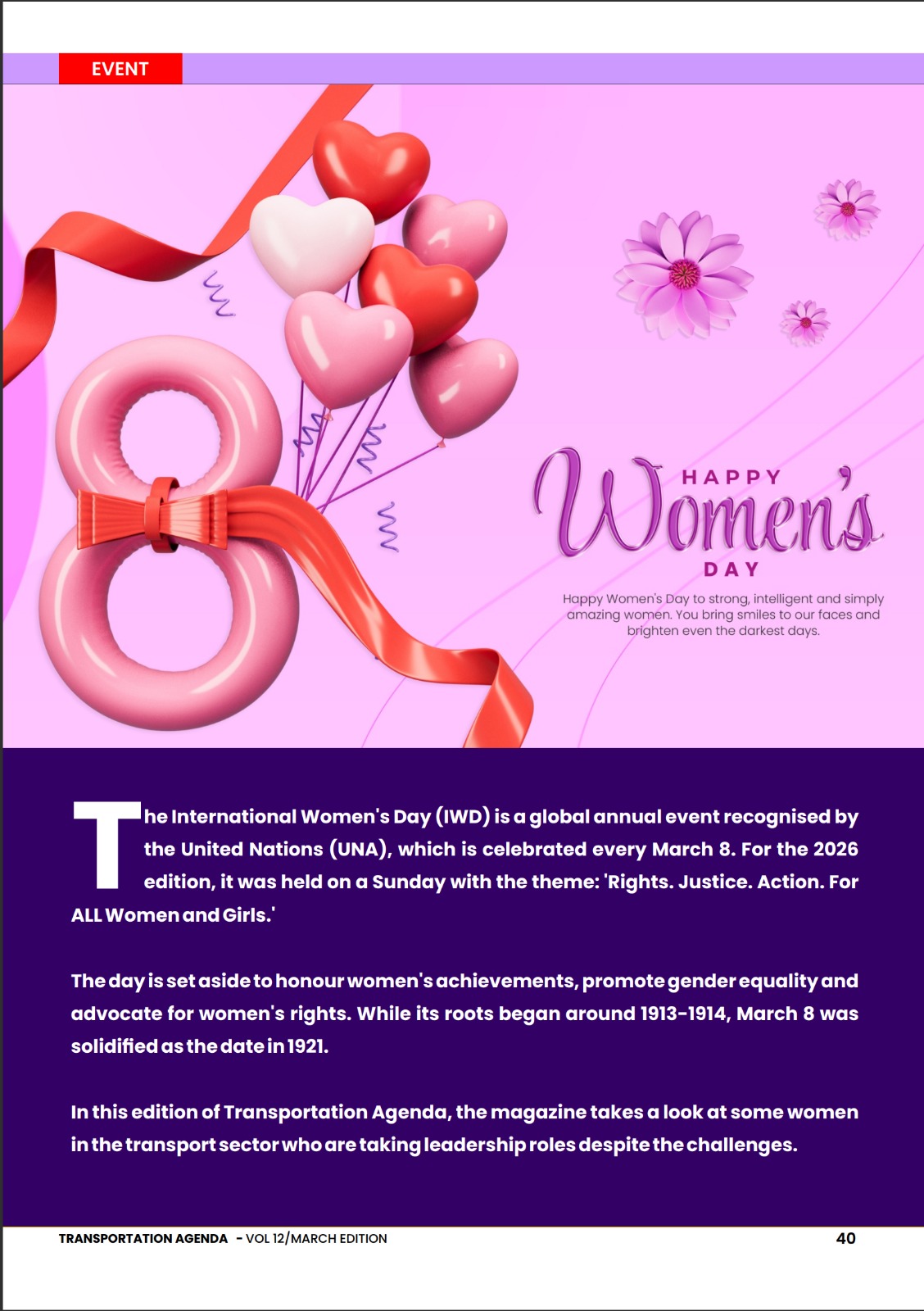
Happy Women’s Day to strong, intelligent and simply amazing women. You bring smiles to our faces and brighten even the darkest days.
The day is set aside to honour women’s achievements, promote gender equality and advocate for women’s rights. While its roots began around 1913–1914, March 8 was solidified as the date in 1921.
In this edition of Transportation Agenda, the magazine takes a look at some women in the transport sector who are taking leadership roles despite the challenges.
Mfon Usoro: Architect of Maritime Law, Institutional Reform In Nigeria
Mfon Ekong Usoro stands as one of the most influential and distinguished figures in Nigeria’s maritime sector, a trailblazer whose career has combined legal expertise, institutional reform, policy development, and international engagement to shape the trajectory of the country’s blue economy.
Born on June 12, 1960, Usoro’s professional journey reflects a rare fusion of academic excellence and practical impact. Armed with degrees from the University of Calabar, the University of Buckingham, and University College London, where she obtained a Master’s degree in Maritime Law, she built a strong intellectual foundation that would later define her contributions to maritime governance and legal frameworks in Nigeria.
Usoro’s emergence as a key maritime player became most evident during her tenure as the pioneer Director-General and Chief Executive Officer of the Nigerian Maritime Administration and Safety Agency (NIMASA). As the first woman to head a maritime agency in Nigeria, she not only broke gender barriers but also laid institutional foundations that continue to guide maritime safety regulation, shipping development, and administrative efficiency in the country. Her leadership at NIMASA is widely regarded as transformative, marking a shift toward structured regulatory practices and stronger legal underpinnings for maritime operations.
Beyond national service, Usoro’s influence extends across Africa and the global maritime community. She served as Secretary-General of the Abuja Memorandum of Understanding on Port State Control, an intergovernmental organization covering over twenty countries. In this role, she coordinated regional efforts to ensure compliance with international maritime safety and environmental standards, working closely with the International Maritime Organization. Notably, she became the first woman to occupy this position, reinforcing her reputation as a pioneer in a traditionally male-dominated field.
A defining feature of Usoro’s career is her profound contribution to maritime legislation and policy formulation in Nigeria. She played a leading role in drafting critical laws such as the NIMASA Act 2007 and the Coastal and Inland Shipping (Cabotage) Act 2003, among others. These legislative instruments have been central to regulating Nigeria’s shipping industry, promoting indigenous participation, and strengthening institutional governance. Her work also extends to broader transport policy, where she chaired committees responsible for shaping Nigeria’s national transport framework.
In the private sector, as Managing Partner of Paul Usoro & Co., she has continued to influence maritime law and international trade through advisory services, dispute resolution, and capacity building. Her authorship of the maritime law text “International Trade and Carriage of Goods by Sea: Text, Cases, and Materials” further underscores her intellectual leadership, offering practical guidance for legal practitioners, regulators, and stakeholders in global shipping and commerce.
Usoro’s leadership extends into professional and institutional development. As President of the Chartered Institute of Logistics and Transport Nigeria (CILT Nigeria), she revitalized the organization, significantly improving its financial strength and professional relevance. Her advocacy consistently emphasizes a coordinated, “whole-of-government” approach to maritime development, stressing that collaboration across agencies and sectors is essential for Nigeria to compete globally.
Her influence is also evident in strategic projects such as the Ibom Deep Sea Port initiative and regional maritime development frameworks, where she has served in advisory and leadership capacities. She has contributed to African Union maritime charters, environmental protection initiatives, and coastguard development frameworks, demonstrating a holistic understanding of maritime ecosystems that goes beyond shipping to include sustainability and regional security.
What distinguishes Mfon Usoro as an outstanding maritime player is not merely the positions she has held, but the depth and breadth of her impact. She has functioned as a reformer, a policy architect, a legal authority, and a thought leader—consistently shaping discourse and driving progress in Nigeria’s maritime industry. Her career reflects a commitment to excellence, institutional development, and the positioning of Nigeria as a maritime hub within Africa and the global economy.
In a sector often challenged by structural inefficiencies and underutilized potential, Usoro’s voice remains both authoritative and visionary. She continues to advocate for improved governance, infrastructure development, and strategic coordination to unlock Nigeria’s vast maritime potential.
Ultimately, Mfon Ekong Usoro’s legacy is that of a pioneer whose contributions have not only advanced maritime law and administration but have also redefined the possibilities for leadership, gender inclusion, and sustainable development within Nigeria’s maritime domain.
Vicky Haastrup: The Powerhouse Behind Nigeria’s Port Transformation and Private Sector Maritime Success
Princess Vicky Haastrup stands as one of the most formidable and influential figures in Nigeria’s maritime industry, a leader whose career has significantly shaped port operations, private sector participation, and institutional development within the nation’s blue economy. Her journey reflects a powerful blend of resilience, administrative acumen, and visionary leadership in a sector historically dominated by men.
She built her academic and professional foundation in the United Kingdom, studying Business Management at Holborn College and undertaking further training at institutions such as the London Business School and Pitman Central College. This early exposure to global business practices equipped her with the technical competence and strategic insight that would later define her success in Nigeria’s complex maritime environment.
Haastrup’s professional career began in the oil and gas sector, where she spent over two decades at the Nigerian National Petroleum Corporation (NNPC), rising to the position of Special Assistant to the Minister of Petroleum and Energy. This extensive experience in a critical sector of the Nigerian economy provided her with deep knowledge of large-scale operations, governance structures, and resource management,skills she would later transfer seamlessly into maritime administration.
Her transition into the maritime sector in 2006 marked a turning point, both for her career and for Nigeria’s port industry. As the co-founder and Executive Vice Chairman/Chief Executive Officer of ENL Consortium Limited, she assumed responsibility for the management of Terminals C and D at the Lagos Port Complex, Apapa, one of the busiest and most strategic port facilities in the country. Under her leadership, these terminals underwent a remarkable transformation, evolving from inefficient, under-resourced facilities into modern, professionally managed operations capable of handling cargo efficiently and contributing significantly to national trade.
Haastrup’s impact is closely tied to Nigeria’s port concession programme, a major reform initiative that transferred port operations from government control to private operators. Widely recognized as a key driver of this transformation, she has been described as the “Face of Port Concession in Nigeria,” reflecting her central role in demonstrating the viability and success of private sector participation in port management. Through substantial investments in infrastructure, equipment, and human capital, her company helped improve cargo handling efficiency, reduce congestion, and enhance overall port productivity.
Beyond her corporate leadership, Haastrup has played a critical role in shaping industry-wide policies and collaboration. As Chairman of the Seaport Terminal Operators Association of Nigeria (STOAN), she represents the collective interests of terminal operators, advocating for regulatory consistency, infrastructure development, and a more enabling business environment. Her voice has been instrumental in highlighting systemic challenges such as policy instability and poor port access infrastructure, while also proposing solutions to unlock the sector’s vast economic potential.
Her contributions extend further into professional development and capacity building within the maritime sector. As President of the Certified Institute of Shipping of Nigeria and a trustee of organizations such as Women in Logistics and Transport (WILAT), she has championed education, mentorship, and gender inclusion. In doing so, she has not only strengthened institutional frameworks but also inspired a new generation of women to pursue careers in maritime and logistics.
Recognition of Haastrup’s achievements has been both national and international. She has received numerous awards, including the Maritime Woman of the Year, the Centre for Values in Leadership Award of Excellence, and leadership honours from professional bodies such as the Institute of Chartered Accountants of Nigeria. These accolades underscore her exceptional influence and the respect she commands across the maritime and business communities.
What distinguishes Vicky Haastrup as an outstanding maritime player is her ability to combine operational excellence with strategic vision. She has not only managed one of Nigeria’s most important port terminals but has also helped redefine how ports are run, introducing efficiency, professionalism, and global best practices into the system. Her leadership has demonstrated that indigenous private operators can compete on the global stage while contributing meaningfully to national economic development.
In a broader sense, her legacy lies in her role as a reformer and pathfinder. She has proven that strong leadership, when combined with innovation and determination, can transform even the most challenging sectors. Through her work, Nigeria’s maritime industry has witnessed measurable progress, and her continued advocacy ensures that the sector remains positioned for future growth.
No doubt, Princess Vicky Haastrup embodies the qualities of a visionary maritime leader, resilient, forward-thinking, and deeply committed to national development. Her story is not just one of personal success but of enduring impact on an industry that remains central to Nigeria’s economic prosperity.
Iroghama Ogbeifun: Driving Indigenous Shipping Growth and Innovation in Nigeria’s Maritime Industry
Iroghama Ogbeifun has emerged as one of the most dynamic and forward-thinking figures in Nigeria’s maritime industry, a leader whose influence spans marine logistics, shipping development, policy advocacy, and gender inclusion. Her rise within a highly technical and traditionally male-dominated sector reflects not only personal resilience but also a broader shift toward innovation and indigenous capacity building in Nigeria’s blue economy.
As the Managing Director and Chief Executive Officer of Starzs Investments Company Limited, Ogbeifun occupies a central role in one of Nigeria’s leading indigenous ship-owning and marine logistics firms. The company provides offshore vessel support services to both international and local oil and gas operators, positioning it as a critical player in the country’s maritime and energy value chain. Her leadership has been marked by strategic growth and operational excellence; under her stewardship, the company expanded its fleet significantly, from just three vessels in 2014 to over a dozen within a few years, solidifying its status as a major contributor to Nigeria’s maritime logistics capacity.
Ogbeifun’s journey into maritime leadership is particularly compelling because it was not originally preordained. With an academic background in Biology, Psychology, and Public Health from institutions such as the University of Massachusetts and Brunel University, she initially charted a path outside the maritime domain. However, upon joining the family-founded business, she quickly demonstrated strategic insight and leadership capability, rising from Executive Director to Chief Operating Officer and eventually CEO. Her progression underscores a blend of adaptability, intellectual depth, and managerial competence that has become her hallmark.
Beyond corporate leadership, Ogbeifun has played an influential role in shaping maritime policy and industry collaboration in Nigeria. As Chairman of the Technical Committee of the Shipowners Association of Nigeria, she contributes to discussions on regulation, indigenous participation, and sustainable growth within the shipping sector. Her expertise and reputation for excellence earned her appointment to the Governing Board of the Nigerian Maritime Administration and Safety Agency in 2025, an important national role that places her at the heart of maritime policy direction and institutional governance.
A defining feature of Ogbeifun’s impact is her commitment to advancing Nigeria’s blue economy. She has consistently advocated for stronger local content participation, improved shipbuilding capacity, and better implementation of maritime policies such as the Cabotage Act. Through her leadership, she has emphasized the need for Nigeria to harness its maritime resources more effectively, positioning the sector as a key driver of economic diversification and national development.
Equally significant is her role as a champion of gender inclusion in maritime and energy industries. In an environment where female representation remains limited, Ogbeifun has used her platform to promote opportunities for women, from corporate leadership to seafaring roles. She is actively involved in initiatives that support mentorship, capacity development, and visibility for women professionals, helping to reshape the narrative around gender participation in the sector.
Her influence extends beyond maritime operations into entrepreneurship and thought leadership. As a multi-sector entrepreneur and public speaker, she has contributed to conversations on business growth, leadership, and innovation across Nigeria and internationally. Her achievements, including winning The Next Titan entrepreneurial reality show and receiving multiple industry awards, reflect her broad impact and recognition as a transformative leader.
What sets Iroghama Ogbeifun apart as an outstanding maritime player is her ability to integrate vision with execution. She is not only building a successful maritime enterprise but also contributing to the institutional and policy frameworks that sustain the industry. Her leadership embodies a new generation of Nigerian maritime professionals, globally aware, innovation-driven, and committed to national development.
In a sector critical to Nigeria’s economic future, Ogbeifun represents both continuity and change: continuity in sustaining indigenous maritime enterprise, and change in redefining leadership, inclusion, and strategic direction. Her story is one of transformation, of a professional who has risen to prominence through competence and courage, and who continues to shape the future of Nigeria’s maritime industry with clarity of purpose and enduring impact.
ENGR. Mrs. Abimbola Akinajo– Managing Director, LAMATA – Championing Lagos Mass Transit Revolution
The Managing Director of the Lagos Metropolitan Area Transport Authority (LAMATA), Engr. Mrs Abimbola Akinajo is one of the few women driving the transportation sector with her headship of LAMATA.
LAMATA is the Lagos State Government agency responsible for planning, implementing, regulating, and franchising public transport infrastructure and operations. It is in charge of the Lagos State Mass Transit System encompassing the road transportation and the train operations under the Lagos Metro line systems under which the Blue Line and Red Line have become operational.
Behind these giant strides in Lagos transportation is Engr. Abimbola Akinajo, the Managing Director.
Engr. Akinajo is a chartered civil engineer (both in the UK and Nigeria) with over thirty years post qualification experience, the last 25 of which has been in the design and delivery of major transport (both Rail and Road) infrastructure projects.
She earned a B.Sc. (Hons) Civil Engineering from the University of Lagos, Nigeria after which she proceeded to the United Kingdom where she started her engineering career.
She began her engineering career at WS Atkins Consulting in the UK as a Graduate Engineer and moved on to be a Project Engineer with Robert West Consulting, a Design Manager with Fluor Daniel Limited and finally a Project Manager with London Underground Limited working on railway infrastructure projects.
In the rail industry in the UK, where she spent over 20 years of her professional life, she delivered many high-profile rail infrastructure projects including, major London underground Rail bridge replacement projects, the Connect Project – (implementation of updated communications systems on the entire London Underground system), upgrading the Blackfriars station for the Thames Link project, The East London Line project handover, and London Over ground interface project among others.
In 2009, she became the Managing Director of Nexant Consulting Limited and grew the consulting firm into a reputable quality driven consulting firm with an excellent track record with its clients. She has about three decades experience of working in the railway industry. Engr. Mrs. Akinajo has extensive experience of liaising and coordinating with different stakeholders to ensure timely delivery of projects to program, Budget and specification.
Damilola Olokesusi – Co-Founder/CEO, Shuttlers; aiding commuting for professionals
Damilola Olokesusi is a Nigerian entrepreneur and co-founder/CEO of Shuttlers, a tech-driven transportation company transforming how professionals commute in urban centres like Lagos.
Her journey into the mobility space, she said, was inspired by firsthand frustrations with the inefficiencies, unpredictability, and safety risks associated with public transport in Nigeria.
A defining moment that shaped her entrepreneurial vision was a traumatic experience involving her sister, who fell victim to a “one chance” robbery—a common form of transport-related crime common in Abuja.
This incident, combined with her own commuting struggles, highlighted a widespread problem affecting many urban professionals. Determined to create a safer and more reliable alternative, Olokesusi partnered with her sisters to build a solution that leveraged technology and shared mobility.
Shuttlers was founded to provide a structured, scheduled ride-sharing system tailored to professionals and corporate organizations. Through its mobile app, users can book seats on predefined routes, subscribe to services, and track shuttle movements in real time. The platform offers air-conditioned buses and cars, turning otherwise stressful commutes into opportunities for rest, productivity, and networking. By optimizing shared transport, the company also aims to reduce traffic congestion, lower the number of privately owned vehicles on the road, and minimize environmental impact.
Olokesusi holds a Bachelor’s degree in Chemical Engineering from the University of Lagos. Her background reflects a strong analytical foundation, which she combines with entrepreneurial drive to address real-world challenges. Known for her resilience and problem-solving mindset, she has demonstrated the ability to identify everyday pain points and convert them into scalable business opportunities.
Despite initial skepticism—even from close family members—about launching a tech-enabled transport solution in Nigeria, she remained committed to her vision. Since its pilot phase in 2015, Shuttlers has grown into a recognized player in the mobility sector, earning both local and international acclaim.
Olokesusi’s achievements include winning and participating in prestigious programs such as Demo Africa, the Unreasonable Institute, Women in Africa Contest, and Aso Villa Demo Day, where she engaged with top global and national leaders. Through her work, she continues to champion innovation, improve urban mobility, and contribute to building more efficient and sustainable transport systems across Africa.
Sandra Aguebor – First Female Mechanic demystifying the stereotype
Sandra Aguebor is a pioneering Nigerian auto engineer, entrepreneur, and advocate for women’s empowerment, widely celebrated as the country’s first female mechanic.
Born in Benin City, her life and career represent a powerful story of determination, resilience, and the courage to challenge deeply rooted gender stereotypes in a male-dominated industry.
From a young age, Aguebor developed a keen interest in automobiles, engines, and how mechanical systems function. This passion was nurtured by her father, who encouraged her curiosity at a time when few girls were exposed to such technical interests. Despite societal norms that discouraged women from pursuing careers in engineering and mechanics, she remained steadfast in her ambition.
Her determination led her to study mechanical engineering, equipping her with the technical expertise needed to break into the automotive field.
Aguebor began her professional career as an engineer before taking the bold step of establishing her own auto workshop in Lagos. This achievement was significant, not only because of the technical demands of the work, but also because it challenged long-standing perceptions about women’s roles in society. In an environment where mechanics were almost exclusively male, she proved that competence and professionalism transcend gender.
However, her impact extends far beyond her personal success. Aguebor has dedicated much of her career to empowering other women by equipping them with practical automotive repair skills. Through her training initiatives, she has mentored and trained over 1,000 women, providing them with the knowledge and confidence to pursue careers in mechanics and related trades.
By doing so, she has created pathways for financial independence and self-reliance, helping many women transform their lives.
Her work is not just about fixing cars; it is about breaking barriers and reshaping mindsets. By teaching women how to maintain and repair vehicles, she is also instilling confidence, resilience, and a sense of purpose. Her efforts have contributed to changing perceptions about what women can achieve in technical fields, inspiring a new generation to explore opportunities beyond traditional roles.
Today, Sandra Aguebor stands as a symbol of courage and empowerment in Nigeria’s transport and automotive sector, proving that with passion and determination, barriers can be broken and new paths created.
**Ogochukwu Ugboma – A transport researcher/academic building the next generation of transport experts**
Ogochukwu Ugboma is a distinguished Nigerian academic and transport expert, widely recognised for her contributions to the advancement of logistics, supply chain management, urban mobility, and maritime transportation. With over 15 years of experience in academia, she has built a strong reputation as a thought leader committed to developing the next generation of professionals in Nigeria’s transport and logistics sector.
Ugboma currently serves as the Dean of the School of Transport and Logistics at Lagos State University, where she plays a pivotal role in shaping academic programmes that respond to the evolving needs of the industry. In this capacity, she has been instrumental in bridging the gap between theoretical knowledge and practical application, ensuring that students are well-equipped with the skills required to thrive in a dynamic and highly competitive sector.
Her academic focus spans key areas such as supply chain optimisation, urban mobility systems, and maritime transport development.
Through her teaching, research, and mentorship, Ugboma has consistently emphasised the importance of efficiency, sustainability, and innovation in transport systems. She is particularly passionate about integrating modern logistics practices into Nigeria’s transport framework to improve service delivery and competitiveness.
Beyond the classroom, Ugboma has contributed to policy discussions and industry engagement, providing expert insights on how to strengthen Nigeria’s transport ecosystem. She has worked to connect students with industry stakeholders, creating opportunities for internships, hands-on training, and career placement. This approach not only enhances employability but also ensures that graduates are aligned with real-world demands.
As a mentor, she is deeply committed to nurturing talent and encouraging young professionals—especially women—to pursue careers in transport and logistics. Her leadership reflects a broader vision of inclusivity and capacity building within the sector, where diverse perspectives are seen as essential to innovation and progress.
Odunayo Boyepe Ani – A transport/maritime expert championing greater involvement of women in maritime
Odunayo Boyepe Ani is a distinguished Nigerian chartered accountant, author, and maritime industry leader, renowned for her expertise in finance, auditing, and maritime governance. With over 30 years of professional experience, she has consistently bridged the worlds of financial management and maritime administration, establishing herself as a leading voice in Nigeria’s shipping sector.
Ani currently serves as the Director of Internal Audit at the Nigerian Maritime Administration and Safety Agency (NIMASA), a role in which she ensures financial transparency, accountability, and efficiency within one of Nigeria’s most important maritime institutions. Her work supports NIMASA’s broader objectives, which include enhancing maritime safety, strengthening regulatory compliance, promoting seafarer welfare, and driving sustainable growth in the blue economy. By implementing robust auditing systems and advising on fiscal policies, she has helped elevate operational standards and instill best practices in the agency.
Beyond her official duties, Ani is an influential advocate for gender equity and professional development in the maritime industry. She serves as the President of the Women’s International Shipping and Trading Association Nigeria, a global network dedicated to empowering women in shipping and logistics. Under her leadership, WISTA Nigeria has expanded initiatives focused on mentorship, training, and networking opportunities, helping to break traditional barriers and create pathways for women to succeed in the historically male-dominated maritime sector.
Ani frequently engages in thought leadership, speaking at conferences and industry forums on critical topics such as safe shipping, seafarer training, maritime finance, and the development of the blue economy. Her expertise spans auditing, taxation, and financial management in maritime operations, allowing her to provide insights that are both practical and strategic.
Her career exemplifies a commitment to excellence, innovation, and inclusivity. By combining technical skill with visionary leadership, Ani has not only advanced Nigeria’s maritime industry but has also served as a role model for women aspiring to leadership positions in finance and shipping. Her work continues to influence policies, professional standards, and opportunities for women across the maritime sector, reinforcing her status as one of Nigeria’s most respected maritime professionals.
