
(UPDATED) Grounded for Good: A Chronicle of Nigeria’s Defunct Airlines and the Turbulent Skies They Navigated
- Aviation
- November 28, 2025
- No Comment
- 346
The history of Nigerian aviation is a story of ambitious take-offs and often-tragic landings. The sector has been a graveyard for numerous airlines that once promised to connect the nation and bridge continents. Their stories are inextricably linked to the nation’s economic tides, regulatory challenges, and infrastructural decay.
This article chronicles the major airlines that have ceased operations, presented in chronological order of their founding, unveiling the common threads that led to their ultimate demise.
The Golden Age and Early Giants (1950s – 1980s)
This era saw the birth of a national carrier and the first wave of private airlines, many of which were closely tied to the oil boom and influential individuals.
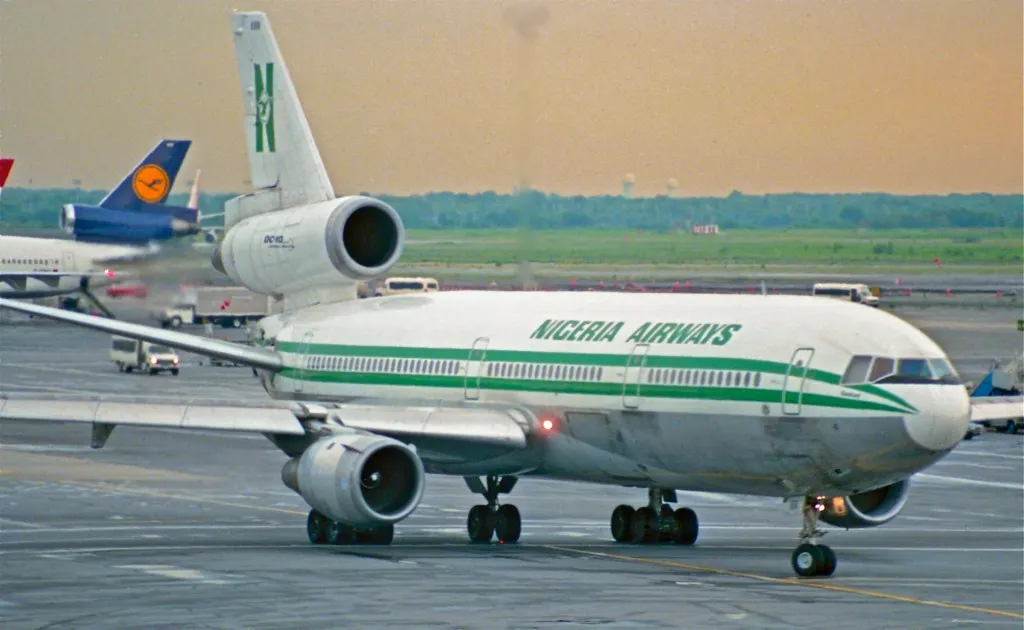
Nigeria Airways (1958 – 2003)
Officially liquidated in 2003 after years of progressive decline. As the national carrier, its fate mirrored that of the nation. It suffered from crippling mismanagement, massive debt, and political interference. The airline became a tool for patronage, with officials and their families flying for free. A bloated workforce, an aging and unsafe fleet, and rampant corruption drained its resources. Attempts at privatization failed, and it was eventually dissolved under President Obasanjo’s government, leaving behind billions in debt and thousands of unpaid pensions.
Kabo Air (1980 – 2020)
A prominent charter airline, famously known as the “Hajj Airline,” which officially suspended scheduled passenger services. It struggled for years with massive debt and an aging fleet of Boeing 747s and 727s. Its demise was driven by crippling maintenance costs and an unsustainable debt profile, ultimately unable to compete in the charter market.
Okada Air (1983 – 1997)
Ceased operations in 1997 amid financial difficulties, managerial challenges, and high operating costs. Okada Air was once the largest domestic carrier. Its end was influenced by economic pressures in Nigeria’s aviation sector, including fuel shortages and rising maintenance expenses. While it faced common issues of high operating costs, the accumulation of financial strain and lack of sustained investment were the decisive factors.
EAS Airlines (1983 – 2007)
Operations suspended and ultimately wound down after the 2002 EAS Airlines Flight 3866 crash in Kano, which killed 73 people. The airline never recovered from the devastating crash and the subsequent loss of public confidence. This was compounded by the financial strain of lawsuits, compensations, and the generally difficult operating environment in Nigeria.
ADC Airlines (1984 – 2009)
Its operating license was revoked by the Nigerian Civil Aviation Authority (NCAA) following the 2006 ADC Airlines Flight 053 crash in Abuja, which killed 96 people, including the Sultan of Sokoto. The fatal crash was the definitive event that grounded ADC. The ensuing investigation, massive reputational damage, and regulatory sanctions made it impossible for the airline to continue operations.
The Post-Deregulation Boom and Bust (1990s – Early 2000s)
The deregulation of the sector in the 1990s led to a proliferation of airlines, but few could withstand the harsh economic realities.
Hold Trade Air (1991 – 2000)
A cargo and passenger airline that ceased operations by 2000. It was grounded primarily due to financial insolvency, facing difficulties in the competitive cargo market, high operational costs, and mounting debts to service providers. Its fleet became outdated without financing for renewal.
Bellview Airlines (1992 – 2009)
Voluntarily shut down operations after years of financial struggle, exacerbated by the 2005 Bellview Airlines Flight 210 crash that killed 117 people. The crash severely damaged its brand. It also faced intense competition from newer airlines like Arik Air and Dana Air, rising debt, and an inability to maintain its fleet reliably, leading to frequent delays and cancellations.
Harka Air (1992 – 2001)
Ceased operations and had its assets seized. Primarily financial insolvency and debts. The airline struggled with the high cost of leasing aircraft and could not generate sufficient revenue to sustain its operations in a competitive market.
Concord Airlines (1991 – 1997)
Concord Airlines was effectively grounded in 1994. This was a direct result of the political crisis and the arrest of its owner, Chief MKO Abiola. Its sole operational aircraft, a Boeing 727, was seized at Lagos airport in 1997 by the military regime of General Sani Abacha. The airline’s fate was inextricably linked to the political trajectory of its famed owner. Its collapse was due to political victimization, as the regime targeted Abiola’s assets. The seizure of its aircraft and financial strangulation under government scrutiny were fatal blows.
Oriental Airlines (1990 – 2003)
A domestic carrier that folded in 2003, succumbing to intense competition and financial pressures. Its operational consistency was hampered by an aging fleet and high maintenance costs, with the difficult early 2000s economic climate delivering the final blow.
Sosoliso Airlines (1994 – 2007)
Shut down permanently after the 2005 Sosoliso Airlines Flight 1145 crash in Port Harcourt, which killed 108 people, 60 of whom were school children. The catastrophic crash destroyed public trust. The ensuing regulatory scrutiny, financial liabilities from the disaster, and the impossibility of rebranding after such a tragedy forced it to cease operations.
Chanchangi Airlines (1994 – 2012)
Slowly faded away due to operational challenges, with its last flight around 2012. The airline was plagued by an aging fleet (primarily Boeing 727s), which became unreliable and expensive to maintain. It faced chronic fuel shortages, huge debts to suppliers like the Nigerian National Petroleum Corporation (NNPC), and could not compete with the modern fleets of its competitors.
Harco Air Services (1992 – 1996)
Had a very brief operational life, ended by a fatal crash in 1996 near Ejirin, Lagos State. The crash shattered public confidence, and the airline lacked the financial resilience to recover, leading to its grounding by regulators.
Spaceworld Air Services (1995 – 2000)
A short-lived domestic airline that ceased operations by 2000. It struggled to achieve profitability on its chosen routes, facing fierce competition and financial insolvency, leading to its rapid exit from the market.
Associated Aviation (1996 – 2013)
Ceased operations after the 2013 Associated Aviation Flight 361 crash in Lagos, which killed 16 people, including key figures in the Nigerian political sphere. The fatal crash led to an immediate suspension of its license by the NCAA and irrevocable reputational damage, leading to its closure.
The 2000s: A Mix of Ambition and Peril
This period saw the entry of ambitious carriers aiming to fill the void left by Nigeria Airways, but they faced a perfect storm of economic and operational crises.
Albarka Air (1999 – 2007)
Folded due to financial difficulties. Operated in the highly challenging regional and domestic market. It succumbed to high operational costs, limited route profitability, and mounting debt.
Afrijet Airlines (1999 – 2009)
Suspended operations and eventually shut down. Faced intense competition on its key routes, high cost of maintenance for its fleet, and the global financial crisis of 2008-2009, which reduced passenger traffic and made financing more difficult.
Trans Sahara Air (2001 – 2004)
A regional airline with a very short lifespan, ceasing operations in 2004. It failed to secure a sustainable market share, plagued from the start by operational inconsistencies and financial difficulties, leading to its early demise.
IRS Airlines (2002 – 2013)
Ceased operations after a series of financial and regulatory challenges. Struggled with high operating costs, an aging fleet of Boeing 737 classics, and inconsistency in operations. It eventually became uncompetitive and financially unsustainable.
Dasab Airlines (2002 – 2007)
Short-lived operation that closed due to financial insolvency. Could not achieve the scale needed to be profitable. It faced the classic challenges of high fuel costs, low passenger load factors, and fierce competition.
Medview Airlines (2004 – 2019)
Its operations became increasingly erratic before it fully suspended services. Its assets were later seized by creditors. After a promising start, Medview collapsed under the weight of crippling debt, a dilapidated and leased fleet that led to constant delays and cancellations, and a failed expansion into international routes (London and Dubai) that drained its financial resources.
Air Nigeria (2004 – 2012)
Ceased operations abruptly in 2012 after years of crisis. Originally Virgin Nigeria, the airline was plagued by a toxic relationship between its owners (Nigerian investors and Virgin Group) and the government. It suffered from massive debt, labour disputes, allegations of financial malfeasance, and a terrible safety reputation that eroded passenger trust.
Virgin Nigeria (2005 – 2010)
Launched with much fanfare as a partnership with Virgin Group before being rebranded to Air Nigeria. It was plagued by a contentious relationship between its foreign technical partners and Nigerian shareholders, suffering from governance issues and massive financial losses that set the stage for its eventual collapse.
The Modern Era and the Persistent Headwinds (2010s – 2024)
Even in the modern era, the fundamental problems of the industry have proven insurmountable for many.
First Nation Airways (2010 – 2018)
Its Air Operator’s Certificate (AOC) was suspended by the NCAA after it failed to return its aircraft from maintenance in years. It never recovered. The core issue was the inability to manage its fleet. Sending its only aircraft for C-checks and failing to get them back created a vicious cycle of no operations, no revenue, and mounting debt. It was a case of poor strategic planning and financial management.
Hak Air (2009 – 2012)
A domestic airline that suspended scheduled flights in 2012 due to financial constraints. It struggled with high operating costs and intense route competition. Its fleet reliability became an issue, leading to frequent cancellations and its quiet exit from the market.
Dana Air (2008 – 2024)
Its AOC was officially withdrawn by the NCAA in April 2024 following an audit after a runway incident. While the 2012 Dana Air Flight 992 crash in Lagos (which killed 163) was a massive blow from which its reputation never fully recovered, the final nail was a series of serious safety incidents and financial troubles. The NCAA’s audit concluded that the airline was no longer fit to operate, citing concerns over its financial health and operational safety.
Azman Air (2014 – 2024)
Suspended operations in early 2024 and had its AOC withdrawn by the NCAA in June 2024. The airline was grounded due to severe financial difficulties and an inability to conduct proper safety audits on its fleet. Like others, it struggled with the high cost of forex for maintenance and leases, leading to an unreliable schedule and loss of customer confidence.
A Pattern of Failure
The chronicle of these defunct airlines reveals a consistent pattern of failure. The primary factors are not isolated incidents but systemic issues. Economic volatility, with high foreign exchange costs, rising fuel prices, and economic recessions, makes profitability elusive. Infrastructural decay, including poor airport facilities and unreliable navigational aids, increases operating costs and risks. Regulatory challenges, while sometimes necessary, often come after a crisis, and inconsistent policies create an uncertain business environment.
Safety and public trust issues mean that a single major crash is often enough to destroy an airline’s reputation permanently in the eyes of the public.
Financial mismanagement leads many airlines to collapse under debt, poor fleet management, and unsustainable expansion plans. Fierce competition in a saturated market on profitable routes leads to price wars that thin margins. Until these fundamental, systemic challenges are robustly addressed, the cycle of ambitious take-offs and painful groundings in Nigeria’s aviation industry is likely to continue.
Path Forward through Government Innovations and Policies for a Resilient Aviation Sector
In response to these systemic challenges, the Nigerian government has enacted a series of reforms aimed at stabilizing the aviation sector. These policies, aligned with International Civil Aviation Organization (ICAO) standards, focus on regulation, infrastructure, liberalization, and safety to create a more sustainable operating environment.
The foundational framework began with the 1964 establishment of the Nigerian College of Aviation Technology (NCAT) and the Civil Aviation Act. This was followed by pivotal moves like the 1989 National Civil Aviation Policy (NCAP), which encouraged private sector involvement and set the stage for deregulation.
Subsequent reforms have steadily modernized the sector. The creation of the Federal Airports Authority of Nigeria (FAAN) in 1995 and the autonomous Nigerian Civil Aviation Authority (NCAA) in 2006 strengthened oversight. Nigeria’s adoption of the Yamoussoukro Decision (1999) and its commitment to the Single African Air Transport Market (SAATM) in 2018 demonstrate a push towards continental liberalization and competitiveness.
Recent initiatives highlight a focus on public-private partnerships, as outlined in the 2015 Aviation Sector Roadmap, to develop maintenance facilities and airport infrastructure. The 2023 NCAP update further emphasizes private sector leadership, integrating advanced safety and environmental systems like CORSIA and sustainable aviation fuel incentives.
Key legislative actions are also reducing operational burdens. The 2024 adoption of the Cape Town Convention simplifies aircraft leasing and financing. More recently, the 2025 Nigerian Insurance Industry Reform Act allows airlines to cede up to 90% of aviation risks internationally, lowering costs for operators.
Ongoing efforts now focus on future-proofing the industry through green investments, net-zero emissions targets, and the development of smart airport infrastructure.
Collectively, these measures represent a comprehensive, multi-decade effort to address the sector’s root vulnerabilities. Their effective implementation is crucial to breaking the cycle of airline failures and building a robust, resilient aviation industry for Nigeria’s future.
By Olusemire Jegede