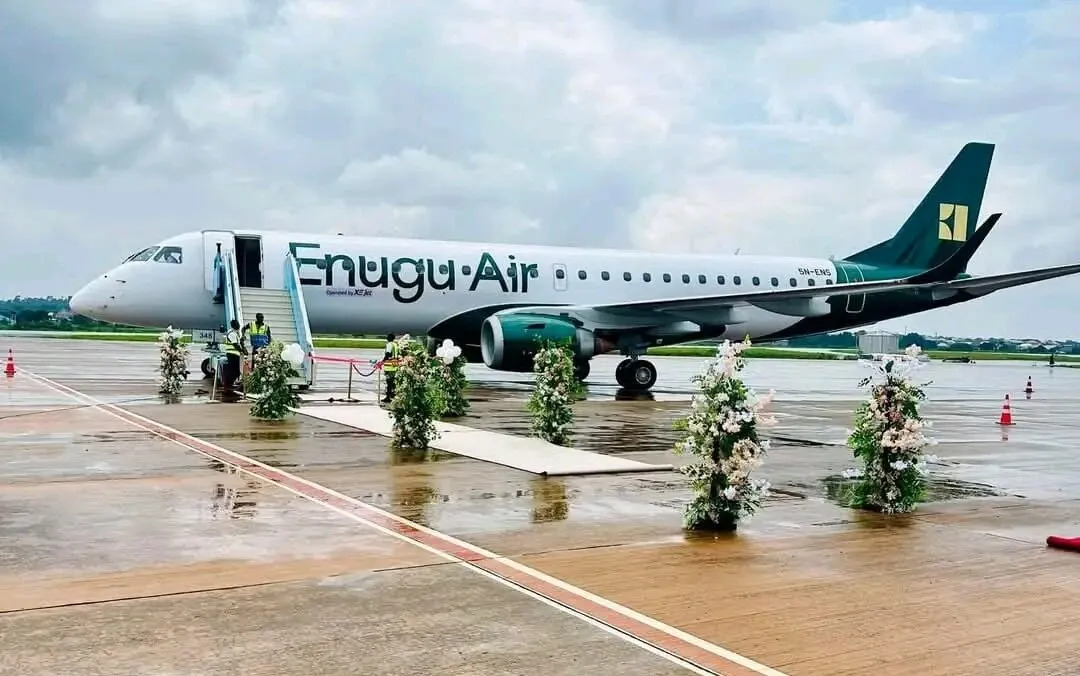

Enugu Air, Airport Concession to Drive State’s $30bn Economic Ambition, Says Commissioner
- Aviation
- June 18, 2026
- No Comment
- 429

The Enugu State Government says its new airline, Enugu Air, and the planned concession of the Akanu Ibiam International Airport are central to its target of expanding the state’s economy from $4.4 billion to $30 billion by 2031.
Secretary to the State Government, Chidiebere Onyia, made the disclosure during the Renewed Hope Media Tour of the airport, outlining how the administration of Governor Peter Mbah intends to use aviation, tourism and agriculture as interconnected drivers of growth.
“We looked at Enugu as an economic hub where tourism, hospitality, investment, and aviation can work together to drive growth,” Onyia said, describing the airport concession as part of a broader strategy to reposition the state as a major economic centre in the South East.
Onyia said the state anticipates a sharp rise in visitor traffic in the coming years and believes air transport will be critical to supporting that growth. He noted that relying solely on commercial airlines could constrain the state’s ability to move people efficiently. “If we’re expecting people to come into Enugu, then we can’t depend solely on third-party airlines based on their schedules,” he explained.
The commissioner revealed that Enugu Air already has six aircraft as the first phase of the project, and said the aviation venture is expected to bolster tourism development. He added that efforts are underway to revitalise tourist sites across the state, and improved access would complement investments in hospitality by making it easier for visitors to reach various destinations.
“If people are going to come here for tourism, they need to be able to get into Enugu, and when they get into Enugu, we’ll need places for them to visit,” he said.
Onyia further noted that the airport infrastructure would support the state’s agricultural development plans through cargo operations, making it easier to move goods and produce within and outside the state and creating more opportunities for businesses and investors.
The government’s vision, he stressed, is to use aviation infrastructure to strengthen trade and economic activities across the region. To ensure efficiency and sustainability, the state adopted a private sector-driven model for both the airline and airport projects, involving industry professionals in the airline’s development and governance structure—a departure from direct government management.
Providing an update on the concession process, Onyia said October has been set as the timeline for the next phase, marking an important milestone that will allow concessionaires and contractors to commence work at the site. He acknowledged the support of President Bola Tinubu and the Federal Ministry of Aviation, noting that federal approvals helped move the initiative from planning to implementation.